Gradient-based Algorithms for Multi-objective Optimization
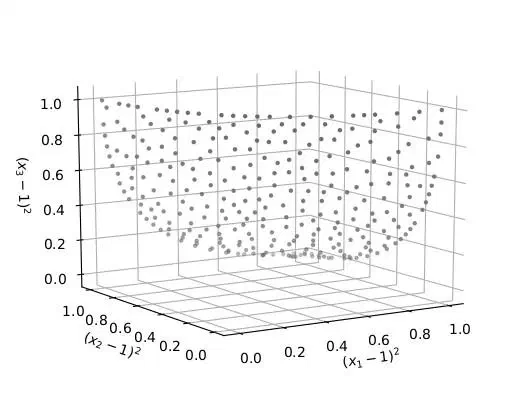 Convergence trajectory of a gradient-based multi-objective solver.
This project addresses the fundamental mathematical challenge of optimizing vector-valued functions without reducing them to a single scalar objective a priori. The core research question is: how do we define and efficiently follow a descent direction when objectives conflict?
While scalar optimization relies on setting the gradient to zero, multi-objective optimization operates under the Karush-Kuhn-Tucker (KKT) conditions for Pareto optimality. Our research focuses on developing rigorous, efficient algorithms to reach these stationary points in continuous, differentiable spaces.
Key Research Topics:
- Descent Directions: Developing algorithms that extend the concepts of Steepest Descent and Newton’s method to multiple objectives, solving the quadratic subproblems required to find common descent vectors.
- Bilevel Optimization: Investigating theoretical properties and solvers for hierarchical problems (Stackelberg games), where one optimization problem is embedded within the constraints of another.
- Pareto Front Approximation: Creating methods to efficiently map the continuous manifold of optimal solutions, rather than finding just a single point.
- JAX Implementation: Leveraging Just-In-Time (JIT) compilation and automatic differentiation to implement these mathematical concepts in the
jaxmoolibrary, providing a low-level, high-performance foundation for researchers.

Marcos M. Raimundo
Professor of Machine Learning and Optimization
My research interests include Machine Learning, Multi-objective Optimization, Ethical AI, mathematical programming.